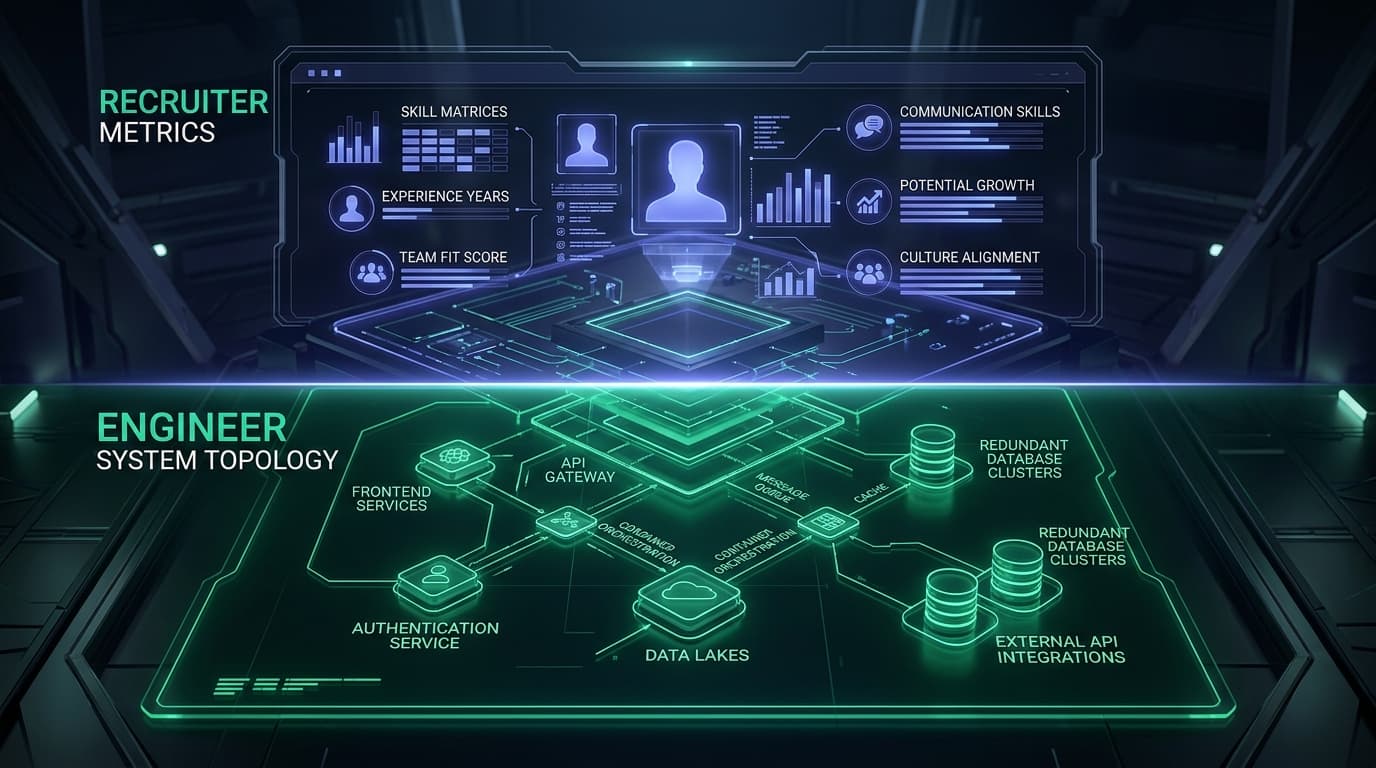
The path to passing high-seniority engineering interviews is understanding that you are not being evaluated by one person—you are being evaluated by two fundamentally different mindsets with conflicting incentives.
The Recruiter’s incentive is risk mitigation: they want to confirm you will not fail the phone screen, demand twice the allocated compensation band, or jump ship after six months.
The Engineering Director’s incentive is force multiplication: they want to know if you can take an ambiguous multi-quarter initiative and guide four engineering teams to production without micromanagement.
Let’s deconstruct a standard Staff Engineer Job Description through both lenses.
1. The Two Very Different Filters
When a candidate applies to a high-level role, their application passes through two distinct gates:
[Candidate Application]
        │
        ▼
[Gate 1: Recruiter / Talent Team] ──► Screen for: Budget, stability, communication, title progression
        │ (Passes)
        ▼
[Gate 2: Technical Panel / Director] ──► Screen for: System design, architectural trade-offs, mentorship
If your resume only appeals to the engineer, you will get rejected by the recruiter. If your interview only appeals to the recruiter, you will fail the system design loop.
2. The Recruiter Lens (Filter 1)
When a talent specialist looks at a Staff Engineer candidate, they scan for three specific markers within the first 45 seconds:
Marker A: Career Trajectory & Tenure
Did this person spend 10 months each at four startups? Or have they stayed at least 2–3 years at an organization, seeing their architecture survive into production and evolve over multiple release cycles?
Marker B: Scope Indicators
Recruiters look for language that indicates organizational influence:
- *"Led technical strategy across 3 squads (18 engineers)"*
- *"Collaborated with VP of Product and Security Compliance to define our SOC2 data pipeline"*
Marker C: Compensation Alignment
Staff compensation varies wildly ($180k base up to $600k+ total compensation at tier-1 tech). Recruiters screen early to ensure expectations match the band.
Recruiter Truth: A recruiter rarely rejects a Staff candidate for not knowing an esoteric database internal. They reject candidates who cannot explain technical concepts simply or who exhibit defensiveness during behavioral queries.
3. The Engineering Director Lens (Filter 2)
Once you pass the initial screen, the technical leadership team tests for something completely different: Trade-off Maturity.
Junior and mid-level engineers tend to believe there is a "right" technical solution. Staff engineers understand that every architecture is merely a collection of trade-offs:
- *"Why did you choose DynamoDB over PostgreSQL for that service?"*
- *"What were the failure modes of that decision 18 months later?"*
- *"How did you handle the eventual consistency lag in your customer billing ledger?"*
If a candidate answers with dogmatic statements (*"Postgres is always better"* or *"Microservices are mandatory"*), the director knows the candidate has not operated systems at true scale.
4. The Architecture & Trade-Off Test
In system design interviews for Staff candidates, interviewers deliberately inject ambiguous requirements to observe how you discover constraints:
# The Prompt:
"Design a real-time notification system for 50 million mobile users."

# The Common Mistake (Mid-Level Reaction):
Immediately starts drawing boxes: Redis, WebSockets, Kafka, push workers.

# The Staff Engineer Reaction:
Asks clarifying constraint questions first:
1. What is the allowable delivery latency? (Sub-second vs. 5-minute batching)
2. What are the notification types? (Critical transactional vs. promotional broadcast)
3. What is the fanout ratio? (1-to-1 alert vs. 1-to-millions breaking news)
The director is evaluating your ability to deconstruct ambiguity before writing a single line of architecture.
5. The Unified Playbook
To succeed across both gates:
- 1.On your resume: Highlight organizational impact, team size, and business metrics for recruiters.
- 2.In your phone screen: Practice concise, executive-level summaries of your career arc without getting bogged down in implementation trivia.
- 3.In the technical loop: Emphasize trade-offs, operational failure stories, and cross-functional alignment.
Prepare for your next technical interview with Skiltrio
Generate custom system design scenarios, coding challenges, and panel evaluation rubrics tailored specifically to any job description in 30 seconds.